Vintage Bicycle Feature: Cinelli Super Corsa, 1951
May 11, 2017
By Mike Barry
Photography by Walter Lai
In the early 1950s, I was a kid living in London with very little money, but an intense interest in everything to do with cycling. My cycling mates and I would ride around London visiting all the bike shops. We could not afford to buy anything, but just looking at the wonderful bike equipment displayed in the shop windows was enough to keep us coming back for more. The shop we visited most often was the Cyclecraft shop in Chiswick, which had a display of marvelous Cinellis. The finish, chrome work and super clean lines were outstanding. To this day, I still think that those early Cinellis were amongst the finest looking bikes ever made.
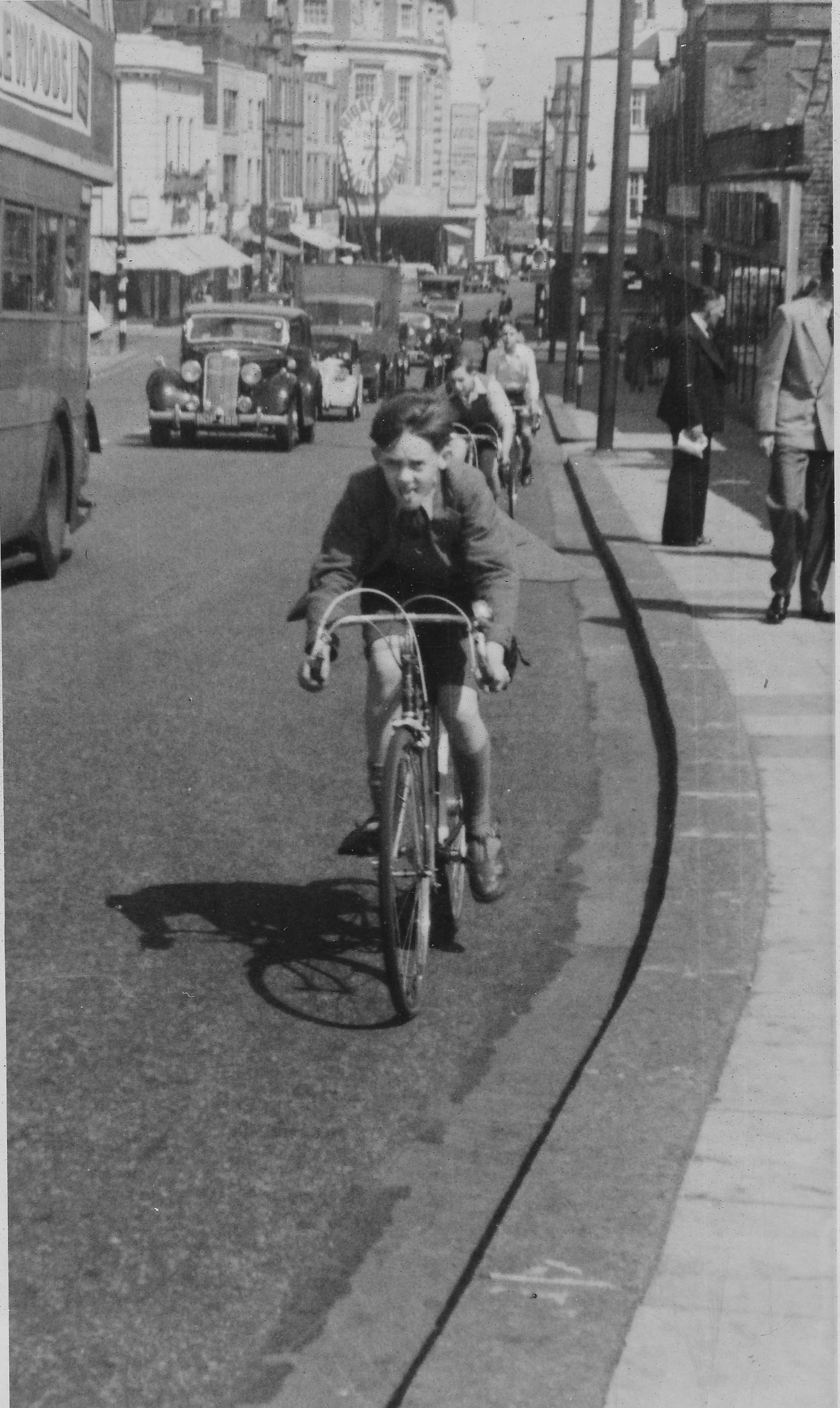
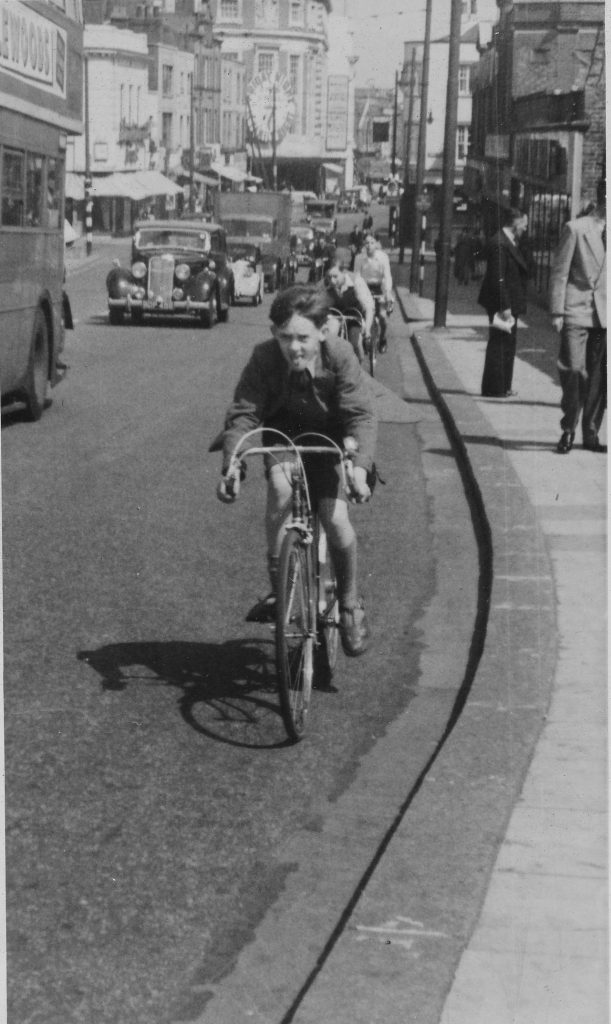 Mike Barry riding through central London with his friends in the late 1940s.
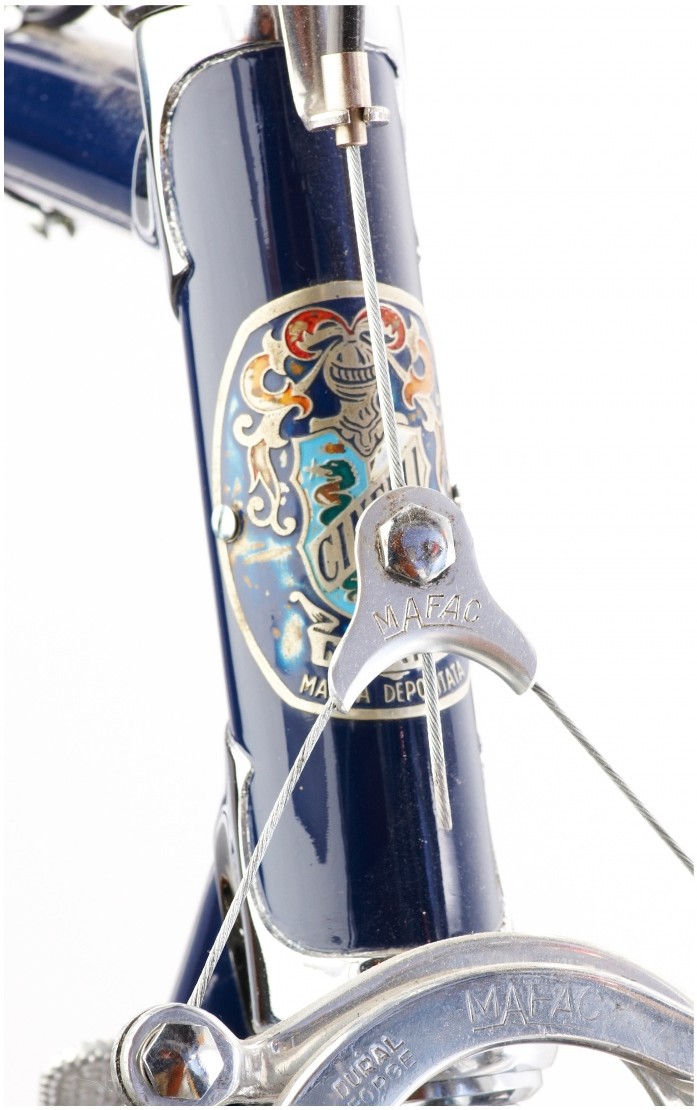 Cinelli Super Course, 1951
When I started bike racing in 1954 there were three governing organizations for the sport in Britain: the Road Time Trials Council (RTTC) administered almost all the time trials in the country: the National Cyclists Union (NCU) controlled all track racing and circuit racing which was usually on disused wartime airfields. An upstart group, the British League of Racing Cyclists (BLRC), was formed in the forties to promote continental style massed start racing on the open road. Until the BLRC came along massed start racing on the open roads was effectively banned in Britain and had been since the turn of the century. The founders of the League discovered that there was no law preventing bike racing on the open roads so within a short time they were organizing major races all around the country.
This caused a major split in the cycling community. BLRC members felt that the NCU was holding the sport back. NCU members felt that the BLRC would bring about the end of all organized racing. Anyone who joined the League was banned from riding Union races. The Union was also the only organization recognized by the world governing body, the Union Cycliste International (UCI). Anyone hoped to ride for Britain was forced to race in union events.
League members tended to be young, keen on all things continental and fervent jazz fans. If two opposing groups of cyclists passed on the road, a cry of “up the League” came from the League group, which attracted a rather obscene response from the Union side. Although I started cycling with a Union club, I was attracted to the League. I was young and Fausto Coppi was my hero. The sport’s greatest moments unfolded on the Continent, and I was beginning to become interested in jazz. Each month, I would wait anxiously for the latest edition of The Leaguer, the official magazine of the BLRC. It was delivered to my home by John Gough, a devout Leaguer himself, who pedaled around our area dropping off copies to all fellow League disciples.
John rode a wonderful Cinelli, which was a very unusual bike in London at that time. Most of us rode locally built bicycles such as Claud Butlers, Holdsworths, Allins, Algums and, in my case, a very nice Stuart Purves. All were good bikes, but the Cinelli was to me the vastly more attractive.
The first time he arrived at our house, the bike was fitted with a Campagnolo Corsa derailleur. It was an outstanding machine. John had the bike custom built in 1951 with special Campagnolo Corsa dropouts. On each of John’s monthly visits, I drooled over the Cinelli. He was even good enough to let me ride it and attempt the intricacies of operating the Corsa derailleur.
Cinelli Super Course, 1951
When I started bike racing in 1954 there were three governing organizations for the sport in Britain: the Road Time Trials Council (RTTC) administered almost all the time trials in the country: the National Cyclists Union (NCU) controlled all track racing and circuit racing which was usually on disused wartime airfields. An upstart group, the British League of Racing Cyclists (BLRC), was formed in the forties to promote continental style massed start racing on the open road. Until the BLRC came along massed start racing on the open roads was effectively banned in Britain and had been since the turn of the century. The founders of the League discovered that there was no law preventing bike racing on the open roads so within a short time they were organizing major races all around the country.
This caused a major split in the cycling community. BLRC members felt that the NCU was holding the sport back. NCU members felt that the BLRC would bring about the end of all organized racing. Anyone who joined the League was banned from riding Union races. The Union was also the only organization recognized by the world governing body, the Union Cycliste International (UCI). Anyone hoped to ride for Britain was forced to race in union events.
League members tended to be young, keen on all things continental and fervent jazz fans. If two opposing groups of cyclists passed on the road, a cry of “up the League” came from the League group, which attracted a rather obscene response from the Union side. Although I started cycling with a Union club, I was attracted to the League. I was young and Fausto Coppi was my hero. The sport’s greatest moments unfolded on the Continent, and I was beginning to become interested in jazz. Each month, I would wait anxiously for the latest edition of The Leaguer, the official magazine of the BLRC. It was delivered to my home by John Gough, a devout Leaguer himself, who pedaled around our area dropping off copies to all fellow League disciples.
John rode a wonderful Cinelli, which was a very unusual bike in London at that time. Most of us rode locally built bicycles such as Claud Butlers, Holdsworths, Allins, Algums and, in my case, a very nice Stuart Purves. All were good bikes, but the Cinelli was to me the vastly more attractive.
The first time he arrived at our house, the bike was fitted with a Campagnolo Corsa derailleur. It was an outstanding machine. John had the bike custom built in 1951 with special Campagnolo Corsa dropouts. On each of John’s monthly visits, I drooled over the Cinelli. He was even good enough to let me ride it and attempt the intricacies of operating the Corsa derailleur.
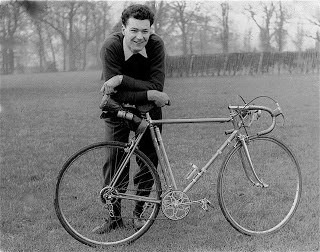 John Gough with the Cinelli, fitted with a Campag Gran Sport derailleur, 1952
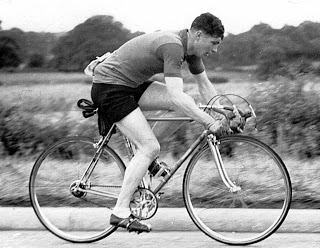 John Gough competing in the Coulsdon-Brighton Time Trial on the Cinelli, with a Campag Corsa derailleur. 1951
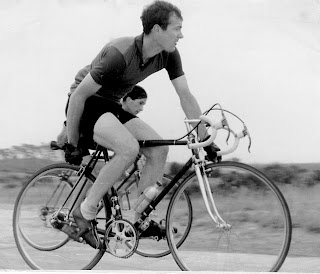 Changing gear on the Cinelli, now fitted with a Campag Paris-Roubaix derailleur and painted blue. 1955
Then on one visit, John said he wanted to sell the frame. I jumped at the opportunity. I put the Purves aside and used the Cinelli for racing.
Changing gear on the Cinelli, now fitted with a Campag Paris-Roubaix derailleur and painted blue. 1955
Then on one visit, John said he wanted to sell the frame. I jumped at the opportunity. I put the Purves aside and used the Cinelli for racing.
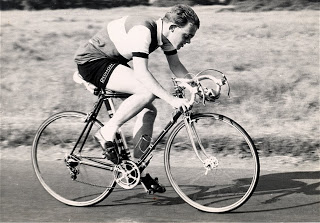 Mike Barry racing on the Cinelli, Chobham England, 1956
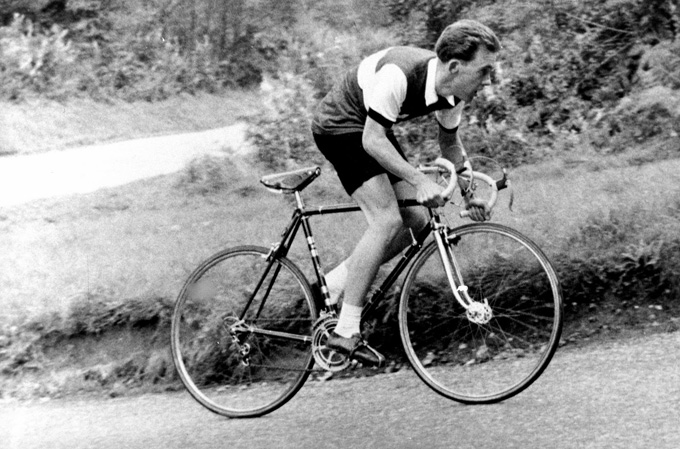 Mike Barry competing on the Cinelli in the Ranmore Hillclimb, 1958.
One time, while carrying the bike to a race on an improvised rack on the back of my Lambretta motor scooter, I hit a pothole in the road and, with a loud crack, the right-hand chainstay broke. The problem had more to do with my rack design than with the durability of the frame. I had it repaired, but a few years later, I found a new Cinelli even more irresistible and I stopped riding the old one.
I kept the old frame and eventually brought it to Canada, where I rode it again until the seat tube and the bottom bracket cracked. I repaired it and had it repainted, but I was unhappy with the paint job. I hung it on the hook in the workshop, waiting for the day when I had time to restore it properly.
35 years later, I took it down and had it refinished to the condition it was in when I raced it in 1958. It had been beige in 1951, when John bought it, but by the time I got it, he’d had it repainted dark blue. After some discussion about the suitable colour, I decided to keep it blue. I imagine many Cinelli enthusiasts will be aghast that I did not have it repainted in the original beige, but I wanted it to look the same as I remembered it.
Mike Barry competing on the Cinelli in the Ranmore Hillclimb, 1958.
One time, while carrying the bike to a race on an improvised rack on the back of my Lambretta motor scooter, I hit a pothole in the road and, with a loud crack, the right-hand chainstay broke. The problem had more to do with my rack design than with the durability of the frame. I had it repaired, but a few years later, I found a new Cinelli even more irresistible and I stopped riding the old one.
I kept the old frame and eventually brought it to Canada, where I rode it again until the seat tube and the bottom bracket cracked. I repaired it and had it repainted, but I was unhappy with the paint job. I hung it on the hook in the workshop, waiting for the day when I had time to restore it properly.
35 years later, I took it down and had it refinished to the condition it was in when I raced it in 1958. It had been beige in 1951, when John bought it, but by the time I got it, he’d had it repainted dark blue. After some discussion about the suitable colour, I decided to keep it blue. I imagine many Cinelli enthusiasts will be aghast that I did not have it repainted in the original beige, but I wanted it to look the same as I remembered it.
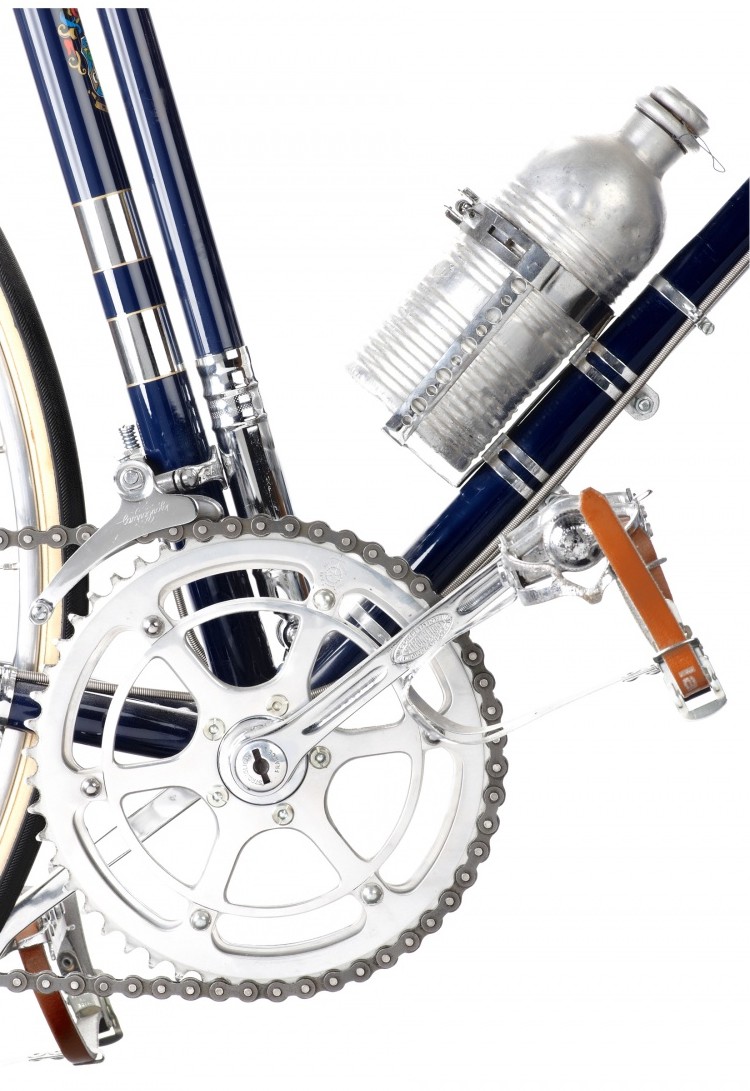 Cinelli Super Course
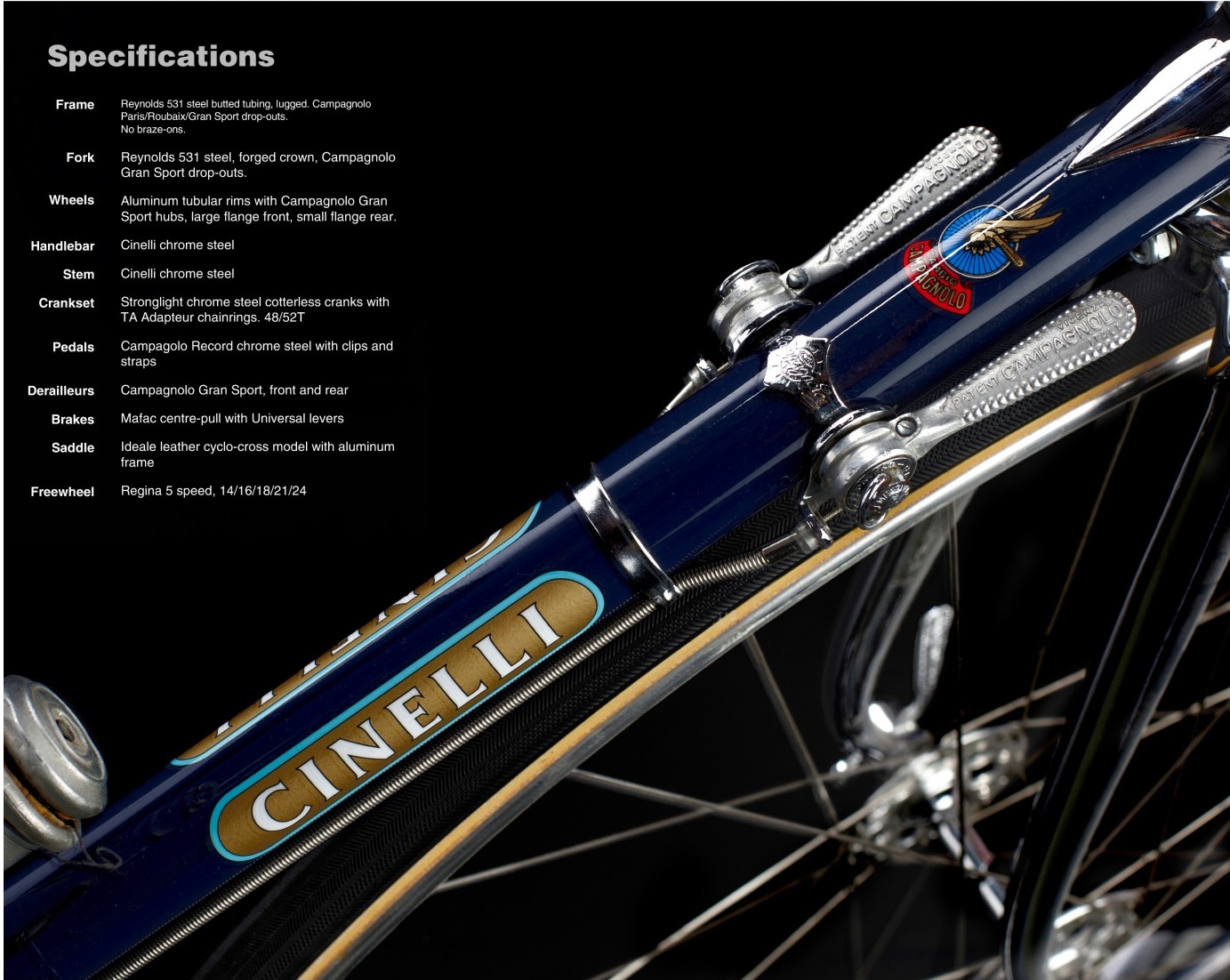
It is now built up with almost the same components as it had in 1958. Some parts are the same ones as I used then. I think it looks better now than it ever did.
Cinelli Super Course
It is now built up with almost the same components as it had in 1958. Some parts are the same ones as I used then. I think it looks better now than it ever did.


 Mike Barry riding through central London with his friends in the late 1940s.