

April 04, 2016
 The bigger the group size, the more intimidating it can be, but if you focus on riding near the front of the group and surrounding yourself with the more experienced riders, you will be safer. You can learn how to descend by following the line of an experienced rider. They will guide you in setting up the turns and twists in the road. Also, when traveling through corners, proper weight balance and pedal placement in critical. Think about having three points of contact when cornering and descending:
1. Sit square on your saddle.
2. In the apex of the sharp turns, be sure to always have your outside foot at 6 o'clock (the base of the pedal stroke) and inside foot at the top of the pedal stroke.
3. Place hand weight/pressure on the inside handlebar and outside foot.
This will help you to maximize centrifugal force and travel safely at high speeds through the turns.
Maintaining position in the group is easiest if you pay close attention to the direction that the wind is traveling and ride in the draft of the riders in front of you. If the wind is coming from the left, you wan to stay on the right side of the riders in front of you, the opposite is true if the wind is coming from the right. If it is a direct headwind, stay within an inch or two of the rear wheel of the rider in front of you and you will save energy. As the road winds and turns, wind direction will shift and you need to adjust accordingly.
Echelons can be tricky to learn for a beginning cyclist, but if you adhere to the drafting advice above, you just need to learn to rotate in the direction of the wind. If the wind is coming from the left, rotate up the right side and down the left. If the wind is coming from the right, do the reverse. If it is a headwind, the group should be in a single line with the front riders taking short pulls and then pulling off and drifting to the back of the group.
The bigger the group size, the more intimidating it can be, but if you focus on riding near the front of the group and surrounding yourself with the more experienced riders, you will be safer. You can learn how to descend by following the line of an experienced rider. They will guide you in setting up the turns and twists in the road. Also, when traveling through corners, proper weight balance and pedal placement in critical. Think about having three points of contact when cornering and descending:
1. Sit square on your saddle.
2. In the apex of the sharp turns, be sure to always have your outside foot at 6 o'clock (the base of the pedal stroke) and inside foot at the top of the pedal stroke.
3. Place hand weight/pressure on the inside handlebar and outside foot.
This will help you to maximize centrifugal force and travel safely at high speeds through the turns.
Maintaining position in the group is easiest if you pay close attention to the direction that the wind is traveling and ride in the draft of the riders in front of you. If the wind is coming from the left, you wan to stay on the right side of the riders in front of you, the opposite is true if the wind is coming from the right. If it is a direct headwind, stay within an inch or two of the rear wheel of the rider in front of you and you will save energy. As the road winds and turns, wind direction will shift and you need to adjust accordingly.
Echelons can be tricky to learn for a beginning cyclist, but if you adhere to the drafting advice above, you just need to learn to rotate in the direction of the wind. If the wind is coming from the left, rotate up the right side and down the left. If the wind is coming from the right, do the reverse. If it is a headwind, the group should be in a single line with the front riders taking short pulls and then pulling off and drifting to the back of the group.
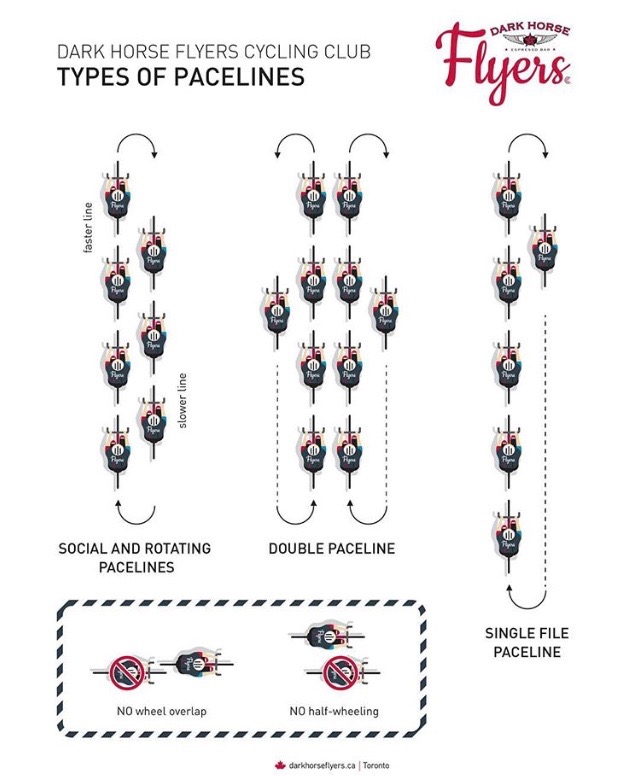 Paceline diagrams by Dark Horse Cycling Club Toronto, Canada
Pacing is important in an echelon as well. Maintaining a steady speed when you pull through on the front is critical. If you speed up rapidly, you can make it difficult for the rider that just pulled to stay with the group and if you slow down, you will cause bunching of the group. If the goal is for the group to increase the speed, do it gradually, as it will be more efficient and you will be able to maintain a higher speed with less risk of dropping riders who are weaker or having a tough moment.
If you feel you are the weak link in the group but want to remain there, sit on the tail end of the group for a rotation or two and take shorter pulls at the front. Save your energy and you will increase your chances of staying with the group.
If you feel you are the strongest rider of the group and the goal is to keep the group intact, don’t surge at the front, as you will wear out and drop the riders who are not as strong. Rather, use your strength to take longer pulls at the same steady speed.
One of the most common bicycle crashes on the group ride is caused by wheel overlap. Riders need to stay close together in order to maximize drafting efficiency, but when riding close, there is little margin for error. As riders fatigue, the likelihood of an overreaction increases if there are bumps in the road. Maintaining focus will increase safety for everyone.
With a little practice with some experienced riding partners you’ll quickly be flying along with a group of friends. On a bike, there are few better feelings than riding at speed in a smooth paceline or cruising over the countryside chatting with friends.
Team Sky Riding In A Tight Paceline
[embed]https://www.youtube.com/watch?v=KUEyBjV2eeA[/embed]
Paceline diagrams by Dark Horse Cycling Club Toronto, Canada
Pacing is important in an echelon as well. Maintaining a steady speed when you pull through on the front is critical. If you speed up rapidly, you can make it difficult for the rider that just pulled to stay with the group and if you slow down, you will cause bunching of the group. If the goal is for the group to increase the speed, do it gradually, as it will be more efficient and you will be able to maintain a higher speed with less risk of dropping riders who are weaker or having a tough moment.
If you feel you are the weak link in the group but want to remain there, sit on the tail end of the group for a rotation or two and take shorter pulls at the front. Save your energy and you will increase your chances of staying with the group.
If you feel you are the strongest rider of the group and the goal is to keep the group intact, don’t surge at the front, as you will wear out and drop the riders who are not as strong. Rather, use your strength to take longer pulls at the same steady speed.
One of the most common bicycle crashes on the group ride is caused by wheel overlap. Riders need to stay close together in order to maximize drafting efficiency, but when riding close, there is little margin for error. As riders fatigue, the likelihood of an overreaction increases if there are bumps in the road. Maintaining focus will increase safety for everyone.
With a little practice with some experienced riding partners you’ll quickly be flying along with a group of friends. On a bike, there are few better feelings than riding at speed in a smooth paceline or cruising over the countryside chatting with friends.
Team Sky Riding In A Tight Paceline
[embed]https://www.youtube.com/watch?v=KUEyBjV2eeA[/embed]